Showing posts with label Education. Show all posts

Saturday, February 14, 2009

The Necklace...

The cheerful little girl with bouncy golden curls was almost five.

Waiting with her mother at the checkout stand, she saw them, a circle of glistening white pearls in a pink foil box.

"Oh Mommy please, Mommy. Can I have them? Please mommy Please...?"

Quickly the mother checked the back of the little foil box and then looked back into the pleading blue eyes of her little girl's upturned face.

"A dollar ninety-five. That's almost $2.00.

If you really want them, I'll think of some extra chores for you and in no time you can save enough money to buy them for yourself.

Your birthday's only a week away and you might get another crisp dollar bill from Grandma."

As soon as Jenny got home, she emptied her penny bank and counted out 17 pennies. After dinner, she did more than her share of chores and she went to the neighbour and asked Mrs. McJames if she could pick dandelions for ten cents. On her birthday, Grandma did give her another new dollar bill and at last she had enough money to buy the necklace.

Jenny loved her pearls. They made her feel dressed up and grown up.

She wore them everywhere, Sunday school, kindergarten, even to bed.

The only time she took them off was when she went swimming or had a bubble bath. Mother said if they got wet, they might turn her neck green.

Jenny had a very loving daddy and every night when she was ready for bed, he would stop whatever he was doing and come upstairs to read her a story. One night as he finished the story, he asked Jenny, "Do you love me?"

"Oh yes, daddy. You know that I love you."

"Then give me your pearls."

"Oh, daddy, not my pearls. But you can have Princess, the white horse from my collection, the one with the pink tail. Remember, daddy? The one you gave me. She's my very favourite."

"That's okay, Honey, daddy loves you. Good night." And he brushed her cheek with a kiss.

About a week later, after the story time, Jenny's daddy asked again, "Do you love me?" "Daddy, you know I love you."

"Then give me your pearls."

"Oh Daddy, not my pearls. But you can have my baby doll. The brand new one I got for my birthday. She is beautiful and you can have the yellow blanket that matches her sleeper."

"That's okay. Sleep well. God bless you, little one. Daddy loves you."

And as always, he brushed her cheek with a gentle kiss.

A few nights later when her daddy came in, Jenny was sitting on her bed with her legs crossed Indian style.

As he came close, he noticed her chin was trembling and one silent tear rolled down her cheek.

"What is it, Jenny? What's the matter?"

Jenny didn't say anything but lifted her little hand up to her daddy.

And when she opened it, there was her little pearl necklace. With a little quiver, she finally said, "Here, daddy, this is for you."

With tears gathering in his own eyes, Jenny's daddy reached out with one hand to take the dime store necklace, and with the other hand he reached into his pocket and pulled out a blue velvet case with a strand of genuine pearls and gave them to Jenny

He had them all the time. He was just waiting for her to give up the dime-store stuff so he could give her the genuine treasure.

So it is, with our God. He is waiting for us to give up the cheap things in our lives so that he can give us beautiful treasures.

Isn't God good? Are you holding onto things that God wants you to let go of?

Are you holding on to harmful or unnecessary partners, relationships, habits and activities that you have come so attached to that it seems impossible to let go?

Sometimes it is so hard to see what is in the other hand but do believe this one thing ...

God will never take away something without giving you something better in its place.

The greatest gifts happen when you share love and touch.

Happy Valentine's Day

Wednesday, February 11, 2009

Worms & Us

Take a trip to meet the charming, slinky creatures that turn your innards into their home sweet home

Worms have been living inside the human body since Homo sapiens have been around. About half the world's population (over 3 billion people) are in infected with at least one of the three worms—large
roundworm, hookworm and whipworm. Most of those afflicted live in developing countries, where there is not enough clean drinking water or effective sanitation systems to keep infected feces from contaminating food and water, and where human excrement is used to fertilize crops. As you browse ahead, please remember that all of these infections are treatable.

Hookworm

Unlike most parasitic worms, which invade the body through the stomach, hookworm larvae can wiggle in through sweat glands or hair follicles in the skin. This typically happens when people walk, sit or lie on dirt containing human feces contaminated by hookworm larvae. Through the skin and into the blood vessels, the larvae make their way to the lungs, causing coughing and shortness of breath; they then migrate to the throat, where they are swallowed and delivered to the small intestine. They mature into adults measuring about 0.4 inch (10 millimeters) long, causing symptoms such as abdominal pain and anemia—a result of the worm sucking blood out of the intestinal walls. Some 740 million people, mostly those living in the warm, moist climates of Africa, Latin America, Southeast Asia and China, suffer from hookworm infections, according to the World Health Organization (WHO).

The Large Roundworm (Ascaris)

Ascariasis, the potentially deadly disease caused by the roundworm Ascaris, is the most common worm infection in humans, affecting as many as 1.5 billion people worldwide annually and striking hardest in tropical and subtropical regions with poor sanitation, according to the U.S. Centers for Disease Control and Prevention (CDC). People often catch ascariasis by ingesting vegetables or fruit grown in soil fertilized with human feces contaminated with its eggs. On hatching in the intestine, the eggs develop into larvae that migrate through the blood and lymph systems into the lungs, causing fever, shortness of breath and wheezing. (Some people actually cough up the larvae.) From the lungs, the larvae make their way up into the throat; there they are swallowed and passed into the small intestine, where they grow into adulthood. (Imagine earthworms as long as one foot, or 30 centimeters, crawling around in your small intestine.) Severe infections can lead to intestinal blockage and death. The WHO estimates that ascariasis causes 60,000 deaths per year, mainly in children.

A Whipworm
Trichuris trichiura, co
mmonly known as a whipworm because it looks like a cow whip, grows up to about two inches (50 millimeters, or as long as a thumb). The most common way to catch whipworm is by ingesting dirt containing human feces that are loaded with its eggs (think: children playing in the dirt and then putting their fingers in their mouths). The whipworm, which sets up shop in the large intestine, is what Despommier says may be "the secret to curing Crohn's disease."

Patients with Crohn's disease—an
autoimmune disorder in which the intestinal tract becomes chronically inflamed, leading to symptoms such as diarrhea, abdominal pain and rectal bleeding—are believed to have small proteins that resemble whipworm proteins jutting from the surfaces of their intestinal cells. Mistaking the protein protrusions for those of a whipworm, the immune system attacks them, causing Crohn's disease, Despommier explains. Studies have shown that when Crohn's patients are infected with whipworm, the body seems to redirect its focus away from its own cells and onto the worms, causing Crohn's symptoms to disappear. The problem with treating Crohn's disease with whipworm, of course, is that the worm causes its own suite of problems, including severe diarrhea, weight loss and anemia. Severe cases [see photo inset] can lead to rectal prolapse, a condition in which the walls of the rectum actually protrude from the anus.

Worldwide, some 800 million people, mostly children in tropical and subtropical climates, are infected with whipworm, according to the National Institute of Allergy and Infectious Diseases.

Lymphatic Filariae

Unlike most parasitic w
orms, which inhabit the intestines, lymphatic filariae live in the lymphatic vessels and nodes. For reasons not completely understood by scientists, the presence of these worms in the lymph system can lead to severe inflammation called elephantiasis, which often affects the legs, arms, genitals and breasts [see photo]. Unfortunately for men, the worms have a propensity for the male genitalia. The worms get inside a person's body when a mosquito carrying their larvae sinks its proboscis into a victim's skin. The larvae travel through the skin and into the lymph vessels where they mature into adults measuring as long as four inches (100 millimeters). According to WHO, the infection usually begins in childhood but often takes years to cause elephantiasis.

Some 120 million peo
ple, mostly in the warm, humid climes of south Asia, Africa and the Americas, are infected with these tiny worms, and more than 40 million are disfigured by the infection, according to WHO.

Ta
peworm
People accidentally ingest immature worms by eating raw or undercooked pork. Once the worms pass into the intestines, they latch onto the intestinal walls with suckers and hooks and begin to grow—and grow. The pork tapeworm shown here, Taenia solium, can grow as long as 20 feet (six meters). Often, people don't even know they have tapeworm until they see the worms—or pieces of them in their stool. If a person ingests the tapeworm eggs (by, for example, drinking water contaminated by egg-laden human feces), the eggs hatch into larvae the stomach and travel into the small intestine. From there, they may enter the bloodstream and migrate to the muscles, eyes or brain, where they can cause seizures, headaches and potentially fatal brain swelling.

Now, if you are interested in teaching your children on the importance of wearing footwear, you could use the video shown below.


Pinworm

Pinworm is the most ubiquitous parasitic worm infecting people in temperate climates—places like the U.S., Europe and most of China, which are neither tropical nor polar, but have four seasons. Nearly all children catch pinworm before they reach age 12 (yes, that means you, too) by digesting tiny bits of fecal matter from other kids. Pinworm inhabits the colon and rectum, feeding on Escherichia coli (E. coli) bacteria in the stool. Late at night when children are asleep, the female pinworm, which measures about the length of a staple (0.5 inch or 13 millimeters), emerges from the anus and lays her eggs on the surrounding skin. The eggs are itchy, causing children to scratch and contaminate their fingers. When they suck their thumbs, or touch other children who suck their thumbs, the cycle starts all over again.

Friday, November 21, 2008

The Great Pyramid Mystery

A theory says ancient Egypt's Great Pyramid was built using a winding, inclined, interior tunnel through which huge blocks were pushed. The interior ramp would have required open corners (illustration at top) at which the blocks would have enough room to be rotated—probably by workers using wooden cranes—the theory says.

The theory may be supported by new ideas about a hidden room high in the pyramid's outer wall. Egyptologist Bob Brier, shown entering the space, says it is in fact one of those open corners, long since walled in.


Illustration and photograph courtesy Jean-Pierre Houdin


Pyramid Mystery to Be Solved by Hidden Room...
By Brian Handwerk
for National Geographic News


ON TV
Unlocking the Great Pyramid airs Sunday, November 23, at 7 p.m. ET on the National Geographic Channel.

A sealed space in Egypt's Great Pyramid may help solve a centuries-old mystery: How did the ancient Egyptians move two million 2.5-ton blocks to build the ancient wonder?

The little-known cavity may support the theory that the 4,500-year-old monument to Pharaoh Khufu was constructed inside out, via a spiraling, inclined interior tunnel—an idea that contradicts the prevailing wisdom that the monuments were built using an external ramp.

The inside-out theory's key proponent, French architect Jean-Pierre Houdin, says for centuries Egyptologists have ignored evidence staring them in the face.

"The paradigm was wrong," Houdin said. "The idea that the pyramids were built from the outside was just wrong. How can you resolve a problem when the first element you introduce in your thinking is wrong?"

Theories Abound
Even the most widely held Great Pyramid construction theories have flaws, Egyptologist Bob Brier said.

For example, a single, straight external ramp would have been impractical, said Brier, of Long Island University in New York.

To deliver blocks to the 481-foot (147-meter) peak at a reasonable grade, the ramp would have had to have been a mile (1.6 kilometers) long and made of stone. And over the decades of the pyramid's construction, workers would have had to continually increase the ramp's height and length as the pyramid rose.

Video Clip From Unlocking the Great Pyramid Documentary


"That's like building two pyramids. And we've never found the remains of such a ramp," Brier said.

Another theory suggests a stone ramp wound around the outside of the Great Pyramid. But an outside ramp would have obscured the pyramid's surface—making it impossible for surveyors to use the corners and edges for necessary calculations during constructions, Brier said.

Greek historian Herodotus, writing around 450 B.C., theorized the use of small, wooden, cranes or levers to lift the blocks.

But, Brier said, "you'd have to have thousands, and they didn't have enough wood in all of Egypt for that," Brier said.

Obsession
For Houdin, the Paris architect, the puzzle of the pyramid is a family affair. His father, a civil engineer, came up with the idea of an internal construction ramp a decade ago.

Houdin was soon hooked, as suggested by his recent book, co-written by Brier—The Secret of the Great Pyramid: How One Man's Obsession Led to the Solution of Ancient Egypt's Greatest Mystery.

Houdin eventually left his architecture firm to pursue the inside-out theory full-time.

For what they thought would be a matter of weeks, he and his wife moved into a 236-square-foot (22-square-meter) studio apartment. They ended up staying for four years, as Houdin toiled away at his self-financed project.

Outside Ramp, Then Internal Tunnel

Houdin's theory suggests the Great Pyramid was built in two stages.

First, blocks were hauled up a straight external ramp to build the pyramid's bottom third, which contains most of the monument's mass, Houdin believes.

Houdin says the limestone blocks used in the outside ramp were recycled for the pyramid's upper levels, which might explain why no trace of an original ramp has been found.

Egyptian-archaeology specialist Josef Wegner sees merit in the recycling idea.

"The notion of using the already quarried smaller blocks to build the lower ramp and then dismantling that for use in upper sections would be a very logical approach to speed up the overall construction process," said Wegner of University of Pennsylvania Museum of Archaeology and Anthropology.

After the foundation had been finished, workers began building an inclined, internal, corkscrew tunnel, which would continue its path up and around as the pyramid rose, Houdin said.

Because the tunnel is inside the pyramid, Brier said, "when they finished getting blocks all the way up to the top this ramp disappeared."

New Clue: The Hidden Room

New evidence uncovered about two-thirds of the way up the Great Pyramid supports the inside-out theory, said Houdin, the architect.

At about the 300-foot (90-meter) mark on the northeastern edge lies an open notch.

On a recent expedition with a National Geographic film crew, Brier—aided by a videographer with mountain-climbing experience—scaled perilous crumbling rocks to reach the notch. (The National Geographic Society owns National Geographic News.)

Ducking inside the notch, Brier entered a small L-shaped room.

He wasn't the first to visit the space, but until now Egyptologists had taken little notice of it.

Houdin, the architect, said the feature figures perfectly with his theory.

Open Corners for Turning Blocks?

For the interior tunnel to work, it would have required open areas at the Great Pyramid's four corners, Houdin says. Otherwise the blocks wouldn't have been able to clear the 90-degree turns.

Like railroad roundhouses, these open corners would have given workers room to pivot the blocks—perhaps using wooden cranes—so the stones could be pushed into the next tunnel.

The notch and room are remnants of one such opening, Houdin claims. They are located at one of the spots where Houdin's 3-D computer models suggest they should be.

Inside the corner space, which was apparently walled in as the pyramid was completed, there should be two tunnel entrances at right angles to one another—each leading to a section of the internal ramp, Houdin believes.

Perhaps all that stands between him and the solution to the mystery are massive blocks that thousands of years ago sealed the tunnel, Houdin said.

If this previously known space truly is the missing link in the puzzle of the Great Pyramid's construction, the question remains why no one would have surmised this by now.

Brier said, "If you weren't thinking about internal ramps and notches and you climbed right by this thing, it wouldn't mean anything to you."

The Other Key Clue

Prior to the room brainstorm, Houdin's most important piece of evidence was the product of good luck.

In 1986 a French team in an ultimately fruitless search for hidden chambers in the Great Pyramid had done a survey of the monument's density using a technique called microgravimetry, which measures the strength of local gravitational fields.

Nearly 15 years later, Houdin was presenting his ramp theory at a conference and was approached by a member of the 1986 team.

The man showed Houdin an image from their survey that they'd dismissed as unexplainable.

But to Houdin, and later Brier, the explanation was clear.

The image shows what looks like a spiraling feature inside the structure's outer walls.

"If I hadn't seen that diagram, I'd probably be thinking this is just another theory," Brier said.

Next Step: Confirmation


The 1986 image, the notch room, and other evidence may make Houdin's theory plausible, but the case is far from closed.

"As with all archaeological theories, the proof is in the pudding, and many logical and compelling theories have fallen by the wayside under the weight of hard evidence," said the University of Pennsylvania's Wegner.

But "verification of the proposed internal spiral ramp would be a remarkable and groundbreaking discovery," Wegner added.

Houdin believes that verification might soon be possible.

He suggests that an infrared camera—positioned about 150 feet (46 meters) from the pyramid—could potentially record subtle differences in interior materials and temperatures. Those variations could reveal clear-cut "phantoms" of the internal ramp.

"What we need is the authorization, by the Egyptian authorities, to stay around for 18 hours, close to the pyramid, with a cooled infrared camera based on an SUV and to take images of three [pyramid] faces every hour during this period," Houdin said.

"A green light from Cairo and the Great Pyramid mystery is over."

Source: National Geographic News..

Tuesday, November 04, 2008

Word Riddle

Am sure all of us must have played riddles with at sometime are the other. The most common and interesting ones i've enjoyed hearing often include:

  1. Name the longest English word?
  2. A headless man had a letter to write; It was read by a man who had lost his sight. The dumb repeated it word for word; And deaf was he who listened and heard.
I learnt about a new one that was interesting in many ways...
Here it goes...

  • What common English word is 9 letters long, and each time you remove a letter from it, it still remains an English word; from nine letters all the way down to a single remaining letter?
To find the answer for this latest one, watch the video below.


Fun Word Riddle - Click here for more home videos


Just in case you were not able to get the answers for the two questions above...
  1. Smiles... There's a mile between two 'S'
  2. The letter in question is the letter "O". It is zero. The man had nothing to write. The blind could read nothing. The person who was dumb could repeat nothing. The deaf man listened and heard nothing.

Sunday, October 26, 2008

When I Am Not Looking....


When you thought I wasn't looking…
Align Center
I saw you hang my first painting on the wall,

and I immediately wanted to paint another one.


When you thought I wasn't looking…

I saw you feed a stray cat,

and I learnt that it was good to be kind.


When you thought I wasn't looking…

I saw you make my favourite cake for me,

and I learnt, even little things are special in life.


When you thought I wasn't looking…

I heard you say a prayer,

and I knew that there is a God and I learned to trust in Him.


When you thought I wasn't looking…

I saw you make a meal for a friend who was sick,

and I learned that we all have to help each other.


When you thought I wasn't looking…

I saw you help people who had nothing,

and I learned that those who have something should give to those who don't.


When you thought I wasn't looking…

I saw you take care of our house & everyone in it,

and I learned to take care of what we have.


When you thought I wasn't looking…


I saw how you handled your responsibilities, even when you didn't feel good,

and I learned that I would have to be responsible when I grow up.


When you thought I wasn't looking…


I saw tears come from your eyes,

and I learned that sometimes things hurt, but it's all right to cry.


When you thought I wasn't looking…

I saw that you cared,

and I wanted to be everything that I could be


When you thought I wasn't looking…

I learned most of life's lessons that I need to know to be a good

and productive person when I grow up.


When you thought I wasn't looking…

I looked at you and wanted to say,

'Thanks for all the things I saw


When you thought I wasn't looking.'


I am sending this to all of the people I know who do so much for others,

but think that no one ever sees.

Little eyes see a lot…


Each one of us -

Parent, Grandparent, Aunt, Uncle, Friends, Teachers…

Influence the life of a child.

Let's be a positive influence on the children around us

Friday, August 22, 2008

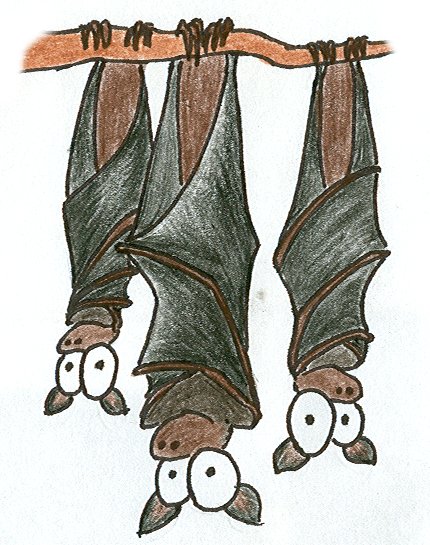
Bats...!


One was flying around my condominium's dim-lit neem tree last night.

…Catching mosquitoes.

I just hoped he didn
't mistake me for one!

It was about 10:30 pm and I had just returned after an evening dinner with a friend of mine and looking out my third floor balcony, the neem
tree whistling in the darkness looked too inviting to pass up.

But as I got down to the tree, there was
this darn bat . . . skimming the tree in zig-zag circles.

And as I stood vulnerable in my evening walking shorts, the bat would come swooping down in 10 second loops on a dive-bomb collision course right toward my face!

But just at the last second . . .

Just as it was inches of crashing into me . . . with the most extraordinary timing, that little winged gymnast would do a seemingly impossible aerial acrobatic and switch directions 180 degrees.


It was totally unnerving.

Do I 'really' want to go out for a walk? I asked myself.


Yeek! Do I want that little creature accidentally bopping me on the head???

We all seem to have an innate and instinctive fear of bats. It probably comes from the bad reputation they've been given on television and in the movies. My environmental science education tells me that in truth, the far majority of bats are completely harmless. In fact, they're great to have around as they clear the air of mosquitoes and other pesky creatures.

But, nevertheless, I still was very hesitant.

Could I trust this bat's radar?

Bats are blind, far crying out loud!

Then I rationalized to myself, well gosh, if its internal guidance system is good enough for it to detect and catch tiny lightening-fast mosquitoes even in complete darkness, it certainly shouldn't have a problem avoiding a 180 cm, 85 kg human being strolling at less than 5 km per hour in the road!

And just as I was thinking that, I was struck by a bolt of wisdom.


I remember reading an article recently about the technique to magnify our inner voice that is always present, but which we often can have a difficult time perceiving and utilizing to our maximum advantage.

Unfortunately thanks to our left-brain educational training, we are cultured from childhood to ignore that inner guidance system in favour of more logical thinking.
And yet, I was like everyone else in our society, often find myself going back and forth, trying to "logically figure out" the solution to my concerns! --

"Should I go in this direction, or should I go in that direction to find greater meaning in my life?"

"Should I trust this friend or colleague who is offering me something, or should I be more cautious before moving ahead?"

"Should I let this slide, or should I say something to someone who just did or said something I don't feel quite comfortable with?"

These questions fly continuously through our heads like a swarm of bats.

But if we don't have a way to get a clear answer, we can find our self going back and forth, wondering why we don't seem to be able to get ahead, improve our relationships, or develop a much higher level of self- esteem and abundance.

So the question is . . .

Are you able to clearly hear what your inner voice is saying to you?

Or do you like I am, oftentimes feel confused, unsure whether the signal we receive is coming from our more superficial logical mind . . . and perhaps some external influence or negative past history . . .

Or is it rising up from the deepest, clearest, most pristine part of our self that 100% of the time knows what's most right and appropriate for us in order for us to increasingly experience more joy, love, inner wealth and abundance?

Now here's the REAL question . . .

How is YOUR Internal Radar System?

Is it finely tuned like the radar of the bat I was witnessing at the tree, where we are able to pluck a perfect answer and solution out of obscure darkness the way that bat at night could pluck tiny mosquitoes out of mid-air?

Or do we find ourself over-thinking and torturing yourself everyday trying to make both big and little decisions that affect our life . . . and our loved ones lives . . . just never quite sure if we're making the right decision?

That's to say . . . how certain . . . or uncertain . . . are we of our own Internal Radar?

Our own Inner Guidance System?

And how much would our life improve if we were able to easily "pluck" from all the bewildering possibilities running endlessly through our mind the one clearest, most appropriate, unmistakable signal, answer and solution to each of our great and small relationship, money and personal challenges?

Personally, I've tried to rely on my own Internal Radar System most of my adult life.
It has on most occasions guided me safely and with extraordinary grace through some major life trials, as well as to living a beautiful life where every day I take both little steps and occasional major leaps to both my dreams and my God-given Vision of what that Inner Guidance System has clearly let me know I'm supposed to accomplish in my life.

My secret?

A lot of hard but joyful work . . .

Taking regular exercise and meditation breaks even when working long hour days.

And having a simple but profound system to obtain crystal clear answers and solutions to any challenge or question I may pose to myself.

What about you . . . my friend?

Friday, July 04, 2008

Good Advertising

Some very good advertisements I got to see in the recent past... Most of them have hard hitting messages...
Am sure you would enjoy watching them...


Tuesday, July 01, 2008

A Problem Like No Other...

Watch the Al Gore's cartoon explaining the process of Global Warming...


Polar bears live only in the arctic and as the sea ice continues to melt due to global warming, the polar bears' primary habitat becomes more threatened. They are incredibly specialized hunters that have adapted to life in the Arctic environment. They depend on the sea ice for survival - it is their hunting grounds; it is their lifeblood. The polar bears featured in this movie are calling us to action as their habitat is threatened. Scientists are calling us to action as they study the current data and make concerning predictions for our future. Future generations are calling us to action as they hope to inherit a better world.

All of the images featured in this movie have been provided by Howard Ruby, Chairman of Oakwood Worldwide, the temporary housing specialist and a supporter of the Global Warming Crusade Fund, LLC. A passionate photographer, his adventures have taken him on numerous trips to the Arctic to photograph this dramatic area and the amazing polar bears and cubs that live there. After witnessing the effects of global warming first-hand and seeing the polar bears' plight, he was moved to assist Oakwood Worldwide in creating the Global Warming Crusade Fund to raise public awareness and to support various research programs and charitable organizations.


Although developed for a Thai commercial for Halls Lite drops, the following video has a hard hitting message presented in a hilarious manner. After laughing if you think a little while, you feel like saying like the famous villain Gabbar "Hamara Kya Hoga Kaaliya..."

The video shows a Polar bear shaving it's fur off to adapt to the increasing global warming. The Arctic grooming leaves polar quite embarassed and puts us to shame. Tears rolled up my eyes when i watched it the first time...


If you were a wildlife biologists, you may question, but polar bears have a black skin below their fur...!

Perhaps all the governments around the world have a similar view to global warming.


Friday, June 27, 2008

Say No To Plastics

The following is a presentation I had developed for addressing a group Students of the Ashok Leyland School, Hosur, Tamil Nadu. The idea for developing this presentation came about from an article in an old issue of National Geographic (Sept 2003), which I picked up from a street vendor in Bangalore the day prior to the programme. Never did i realise that it would become such a widely appreciated presentation from far and wide.

I've uploaded the presentation in the form of a movie with music and posting it below.


The Girl Who Silenced The World....

The following is one of the best speeches I've ever heard, read or listened to. This is the speech of a twelve year young girl giving a speech at the United Nations Earth Summit that took place in Rio de Janeiro 1992.

During the first seconds of the film I didn’t quite understand what was going on - What is that child doing there? - I thought, but I quickly realized, that what I was seeing was something really amazing: a twelve year old child telling to the world that enough is enough, telling to the world leaders to stop destroying the fauna and flora, to stop polluting the air, the ocean and the soil, to end the poverty and social injustices, to stop killing our earth…

This was sixteen years, today Severn Suzuki is is an important environmental activist, was a member of Kofi Annan’s Special Advisory Panel in the past.

I encourage everyone to watch this video, may it serve as an inspiration for us all. (The transcript can be found below.)


Hello, I'm Severn Suzuki speaking for E.C.O. - The Environmental Children's Organisation.

We are a group of twelve and thirteen-year-olds from Canada trying to make a difference:
Vanessa Suttie, Morgan Geisler, Michelle Quigg and me. We raised all the money ourselves to come six thousand miles to tell you adults you must change your ways. Coming here today, I have no hidden agenda. I am fighting for my future.

Losing my future is not like losing an election or a few points on the stock market. I am here to speak for all generations to come.

I am here to speak on behalf of the starving children around the world whose cries go unheard.

I am here to speak for the countless animals dying across this planet because they have nowhere left to go. We cannot afford to be not heard.

I am afraid to go out in the sun now because of the holes in the ozone. I am afraid to breathe the air because I don't know what chemicals are in it.

I used to go fishing in Vancouver with my dad until just a few years ago we found the fish full of cancers. And now we hear about animals and plants going exinct every day -- vanishing forever.

In my life, I have dreamt of seeing the great herds of wild animals, jungles and rainforests full of birds and butterfilies, but now I wonder if they will even exist for my children to see.

Did you have to worry about these little things when you were my age?

All this is happening before our eyes and yet we act as if we have all the time we want and all the solutions. I'm only a child and I don't have all the solutions, but I want you to realise, neither do you!

* You don't know how to fix the holes in our ozone layer.
* You don't know how to bring salmon back up a dead stream.
* You don't know how to bring back an animal now extinct.
* And you can't bring back forests that once grew where there is now desert.

If you don't know how to fix it, please stop breaking it!

Here, you may be delegates of your governments, business people, organisers, reporters or poiticians - but really you are mothers and fathers, brothers and sister, aunts and uncles - and all of you are somebody's child.
I'm only a child yet I know we are all part of a family, five billion strong, in fact, 30 million species strong and we all share the same air, water and soil -- borders and governments will never change that.

I'm only a child yet I know we are all in this together and should act as one single world towards one single goal.

In my anger, I am not blind, and in my fear, I am not afraid to tell the world how I feel.

In my country, we make so much waste, we buy and throw away, buy and throw away, and yet northern countries will not share with the needy. Even when we have more than enough, we are afraid to lose some of our wealth, afraid to share.

In Canada, we live the privileged life, with plenty of food, water and shelter -- we have watches, bicycles, computers and television sets.

Two days ago here in Brazil, we were shocked when we spent some time with some children living on the streets. And this is what one child told us: "I wish I was rich and if I were, I would give all the street children food, clothes, medicine, shelter and love and affection."

If a child on the street who has nothing, is willing to share, why are we who have everyting still so greedy?

I can't stop thinking that these children are my age, that it makes a tremendous difference where you are born, that I could be one of those children living in the Favellas of Rio; I could be a child starving in Somalia; a victim of war in the Middle East or a beggar in India.

I'm only a child yet I know if all the money spent on war was spent on ending poverty and finding environmental answers, what a wonderful place this earth would be!

At school, even in kindergarten, you teach us to behave in the world. You teach us:

* not to fight with others,
* to work things out,
* to respect others,
* to clean up our mess,
* not to hurt other creatures
* to share - not be greedy.
Then why do you go out and do the things you tell us not to do?

Do not forget why you're attending these conferences, who you're doing this for -- we are your own children. You are deciding what kind of world we will grow up in. Parents should be able to comfort their children by saying "everyting's going to be alright" , "we're doing the best we can" and "it's not the end of the world".

But I don't think you can say that to us anymore. Are we even on your list of priorities? My father always says "You are what you do, not what you say."

Well, what you do makes me cry at night. You grown ups say you love us. I challenge you, please make your actions reflect your words. Thank you for listening.

Wednesday, June 04, 2008

Ant and the Grasshopper

An Old Story

The Ant works hard in the withering heat all summer building its house and
laying up supplies for the winter.

The Grasshopper thinks the Ant is a fool and laughs & dances & plays the
summer away.

Come winter, the Ant is warm and well fed.

The Grasshopper has no food or
shelter so he dies out in the cold.


The Modern Indian Version


The Ant works hard in the withering heat all summer building its house and
laying up supplies for the winter.

The Grasshopper thinks the Ant's a fool and laughs & dances & plays the
summer away.

Come winter, the shivering Grasshopper calls a press conference and
demands to know why the Ant should be allowed to be warm and well fed while others are cold and starving.

NDTV, BBC, CNN show up to provide pictures of the shivering Grasshopper
next to a video of the Ant in his comfortable home with a table filled with food.

The World is stunned by the sharp contrast. How can this be that this poor
Grasshopper is allowed to suffer so?

Arundhati Roy stages a demonstration in front of the Ant's house.

Medha Patkar goes on a fast along with other Grasshoppers demanding that
Grasshoppers be relocated to warmer climates during winter.

Mayawati states this as `injustice' done on Minorities.


Amnesty International and Koffi Annan criticize the Indian Government for
not upholding the fundamental rights of the Grasshopper.

The Internet is flooded with online petitions seeking support to the
Grasshopper (many promising Heaven and Everlasting Peace for prompt support as against the wrath of God for non-compliance).

Opposition MPs stage a walkout. Left parties call for 'Bengal Bandh' in
West Bengal and Kerala demanding a Judicial Enquiry.

CPM in Kerala immediately passes a law preventing Ants from working hard
in the heat so as to bring about equality of poverty among Ants and Grasshoppers.

Lalu Prasad allocates one free coach to Grasshoppers on all Indian Railway
Trains, aptly named as the 'Grasshopper Rath'.

Finally, the Judicial Committee drafts the ' Prevention of Terrorism
Against Grasshoppers Act' [POTAGA], with effect from the beginning of the winter.

M. Karunanidhi urges the central government to expedite the clearance for the special bridge between the Grasshopper and Ants. Says, it would bring about equanimity amongst all in the Dravidian world!

Arjun Singh makes 'Special Reservation ' for Grasshoppers in Educational
Institutions & in Government Services.

The Ant is fined for failing to comply with POTAGA and having nothing left
to pay his retroactive taxes,it's home is confiscated by the Government and handed over to the Grasshopper in a ceremony covered by NDTV.

Arundhati Roy calls it ' A Triumph of Justice'.


Lalu calls it 'Socialistic Justice '.


CPM calls it the ' Revolutionary Resurgence of the Downtrodden '


Koffi Annan invites the Grasshopper to address the UN General Assembly.


Many years later...


The Ant has since migrated to the US and set up a multi-billion dollar

company in Silicon Valley,

100s of Grasshoppers still die of starvation despite reservation somewhere

in India,
.
.
.
AND

As a result of loosing lot of hard working Ants and feeding the
grasshoppers,
.

.

.

.

.

.

.

.
.
.

India is still a developing country…!!!


P.S

If you are interested, you may want to show this old video, with a two minutue introduction by Walt Disney, based on the classic Aesop fable, the grasshopper plays his fiddle and lives for the moment, thinking "The world owes me a living". The industrious ants squirrel away massive amounts of food for the winter. The grasshoppers convinces one small ant to accompany his music with a dance, until the queen arrives and scares him back to work. The queen warns the grasshopper of the trouble he'll be in, come winter. Winter comes, and the grasshopper, near starvation, stumbles across the ants, who are having a full-on feast in their snug little tree. They take him in and warm him up. The queen tells him only those who work can eat so he must play for them, where he finally realizes he "owe(s) the world a living"


Saturday, May 24, 2008

The Future of Food

We used to be a nation of farmers, but now it's increasingly becoming lesser and lesser in India. So a lot of us don't know a lot about what it takes to grow food.

There is a revolution happening in the farm fields and on the dinner tables around the world-- a revolution that is transforming the very nature of the food we eat.

THE FUTURE OF FOOD offers an in-depth investigation into the disturbing truth behind the unlabeled, patented, genetically engineered foods that are quietly filling the grocery store shelves.

This film gives a voice to farmers whose lives and livelihoods have been negatively impacted by this new technology. The health implications, government policies and push towards globalisation are all part of the reason why many people are alarmed by the introduction of genetically altered crops into our food supply.

Shot in the U.S., Canada and Mexico, THE FUTURE OF FOOD examines the complex web of market and political forces that are changing what we eat as huge multinational corporations seek to control the world's food system. The film also explores alternatives to large-scale industrial agriculture, placing organic and sustainable agriculture as real solutions to the farm crisis today.

This is a film that every GMO-Food foes must turn to. This stylish film is not just for food faddists and nutritionists. It is a look at something we might not want to see: how GM seeds, collectively are wreaking havoc on agriculture around the world. In the end, this documentary is a eloquent call to action.
The Future of Food provides an excellent overview of the key questions raised by consumers as they become aware of GM foods... It draws questions to critical attention about food production that need more public debate.

In short, "If you eat food, you need to see “The Future of Food!”
The narration and the audio of the video is in English (subtitles are in a different language, though).
Even though this is a long video, see atleast the first 30 mins, you will know what is happening in the agricultural world with the introduction of Gene Revolution.


Thursday, May 08, 2008

Killer Presentation Skills

J. Douglas Jefferys brings twenty-five years of corporate training experience to his role as a principal of PublicSpeakingSkills.com. Mr. Jefferys has personally trained over 15,000 business presenters in his firm's unique presentation design and delivery skills; He is the author of “And Your Point Is?, A primer on proper presentation design, as well as two full-length videos on designing and delivering presentations that are at once compelling and yet easy on both audience and presenter.

Forget everything you've heard about eye-contact, body language, and voice - it's likely either old-school, or just plain wrong. In this very entertaining, knowledge-packed video, you will see and hear for yourself what has been imprisoning the excellent presenter inside you. The video, filmed before a live audience of 200 and enhanced with studio-overlaid visuals of the relevant slides, you will be privy to the most important presentation delivery skills that has heretofore only shared with private corporate clients.


Wednesday, May 07, 2008

How To Prove Anything Right?

Here's an interesting video that is taken from the movie, “In the Navy (1941)”. Watch the characters performed by Abbott and Costello proving 7 x 13 = 28!

W
e can use this film for various purposes.
If you're a HR person, you may want to show that there are many ways to find an answer and that not all answers are right, but the thought process tells us that we think and that is more important!
You can also use it to show you can prove anything right, if you work at it.

Math teachers can use this as an example for teaching place value.

Wednesday, April 30, 2008

150-Year-Old Computer Brought to Life

Charles Babbage--Father of Computing
Born December 26, 1791 in Teignmouth, Devonshire UK (See map below) is known as the "Father
of Computing" for his contributions to the basic design of the computer through his Analytical machine. His previous Difference Engine was a special purpose device intended for the production of tables.

While he did produce prototypes of portions of the Difference Engine, it was left to Georg and Edvard Schuetz to construct the first working devices to the same design which were successful in limited applications.


View Larger Map

Significant Events in His Life
1791: Born;
1810: Entered Trinity College, Cambridge;
1814: graduated Peterhouse;
1817 received MA from Cambridge;
1820: founded the Analytical Society with Herschel and Peacock;
1823: started work on the Difference Engine through funding from the British Government;
1827: published a table of logarithms from 1 to 108000;
1828: appointed to the Lucasian Chair of Mathematics at Cambridge (never presented a lecture);
1831: founded the British Association for the Advancement of Science;
1832: published "Econo
my of Manufactures and Machinery";
1833: began work on the Analytical Engine;
1834: founded the
Statistical Society of London;
1864: published Passages from the Life of a Philosopher;
1871: Passed Away.

A Silicon Valley museum brings inventor, philosopher and alleged music hater Charles Babbage's computing contraption to life

Designed nearly 150 years ago but never actually built until recently, the Difference Engine No. 2 designed by Charles Babbage (1791 to 1871) is a piece of Victorian technology meant to tussle with logarithms and trigonometry long before the first modern computer. Technophiles have a rare opportunity beginning May 10 to see one of these devices (only two exist) on display at the Computer History Museum in Mountain View, Calif.


Babbage's automatic computing engine consists of 8,000 bronze, cast iron and steel parts, weighs five tons, and measures eleven feet (3.4 meters) long and seven feet (2.1 meters) high. Museum guest curator Doron Swade used Babbage's own plans to bring the engine to life.


Babbage is also credited with inventing the cowcatcher, dynamometer, standard railroad gauge and heliograph ophthalmoscope as well as uniform postal rates, occulting lights for lighthouses and Greenwich time signals.

VIVE LA DIFFERENCE
Exhibited for the first time in North America, this is on
e of only two Babbage Difference Engine No. 2 devices ever built.


Charles Babbage's Difference Engine
No. 2, designed in the late 1840s, weighs five tons, is 11 feet (3.4 meters) long and seven feet (2.1 meters) high, and has 8,000 bronze, cast iron and steel parts. The Computer History Museum's Babbage Engine Exhibit launches on May 10, 2008, in Mountain View, Calif.


Blue Print
Babbage's Table of Logarithms of the Natural Numbers, and one of the design drawings from which Doron Swade, director of the Babbage exhibit at the Computer History Museum, masterminded the construction of the Difference Engines at the Science Museum in London.


Carry the 10
Section of the backside of Difference Engine No. 2 showing a portion of the mechanism for carrying tens.


Chapter Wheel
The engine's "chapter wheel," cranked by hand, calculates polynomial functions to 31 decimal places producing one result for each of the engine's cycles. The chapter wheel shows the subdivisions of the cycle.

IT Figures

Part of one of eight columns of figure wheels. There are a total of 248 similar interlocking wheels in Difference Engine No. 2.


Printing Process

The engine's printing apparatus automatically typesets, prints and stereotypes results.


Exclusive Collection

Exhibited for the first time in North America, this is one of only two Babbage Difference Engine No. 2 devices ever built.

Friday, April 25, 2008

The New Anthem of our Country

Times of India had embarked a unique talent search which has the potential to make a huge difference to India. They began a hunt to identify new leaders for a new India, men and women with the vision and ability to empower India with the kind of political leadership that is so conspicuous by its absence.

The Lead India campaign stemmed from the belief that even as India takes giant strides towards fulfilling its undoubted potential, it is doing so despite, not because of, its political leadership. ‘‘Good people don’t want to join politics’’ is an oft-heard lament. And yet, good governance is the cornerstone if India is to overcome the many hurdles that threaten to slow its journey to developed nation status.

And so, the company decided to provide a platform to the good men and women out there who refuse to be daunted by the system, and struggle against massive odds to make life better for their fellow Indians.

A couple of very meaningful advertisement for this initiative…


Wednesday, April 23, 2008

First Lungless Frog

Scientists have first discovered a species of lungless frog, dubbed the Bornean flat-headed frog in a remote clear, cold-water stream in the Kalimantan region on island of Borneo in Indonesia. The frog, named Barbourula kalimantanensis, gets all its oxygen through its skin.

Previously known from only two specimens, two new populations of the aquatic frog were found by the team during a recent expedition to Indonesian Borneo. (See Map Below)


View Larger Map

Serendipity

Nobody knew about the lunglessness before the researchers accidentally discovered it doing routine dissections, says study lead author David Bickford, a biologist at the National University of Singapore. The discovery of lunglessness in a secretive Bornean frog supports the idea that lungs are a malleable trait in amphibians, which represent the evolutionary sister group to all other tetrapods, according to the researchers. They speculate that the loss of lungs might be an adaptation to a combination of factors: a higher oxygen environment, the species’s presumed low metabolic rate, severe flattening of their bodies that increases the surface area of their skin, and selection for negative buoyancy—meaning that the frogs would rather sink to the bottom of the freezing waters it inhabits than float.


Lot More to Be Discovered in Nature
What struck the researcher the most is that there are still major firsts (e.g., first lungless frog!) to be found out in the field. He suggests that you have to do is go a little ways beyond what people have done before, to scream—voila!


Lunglessness

Of all tetrapods (animals with four limbs), lunglessness is only known to occur in amphibians. There are many lungless salamanders and a single species of caecilian, a limbless amphibian resembling an earthworm, known to science. Nevertheless, the complete loss of lungs is a particularly rare evolutionary event that has probably only occurred three times.


Under Threat

The researchers said that further studies of this remarkable frog may be hampered by the species’s rarity and endangerment. They therefore strongly encourage conservation of the frogs’ remaining habitats. This is a highly endangered frog—that we know practically nothing about—with an amazing ability to breathe entirely through its skin, whose future is being destroyed by illegal gold mining by people who are marginalized and have no other means of supporting themselves,” Bickford said. “There are no simple answers to this problem.”


Source

A report in the April 8th issue of Current Biology, a publication of Cell Press.