A theory says ancient Egypt's Great Pyramid was built using a winding, inclined, interior tunnel through which huge blocks were pushed. The interior ramp would have required open corners (illustration at top) at which the blocks would have enough room to be rotated—probably by workers using wooden cranes—the theory says.
The theory may be supported by new ideas about a hidden room high in the pyramid's outer wall. Egyptologist Bob Brier, shown entering the space, says it is in fact one of those open corners, long since walled in.
Illustration and photograph courtesy Jean-Pierre Houdin
Pyramid Mystery to Be Solved by Hidden Room... By Brian Handwerk for National Geographic News
ON TV Unlocking the Great Pyramid airs Sunday, November 23, at 7 p.m. ET on the National Geographic Channel.
A sealed space in Egypt's Great Pyramid may help solve a centuries-old mystery: How did the ancient Egyptians move two million 2.5-ton blocks to build the ancient wonder?
The little-known cavity may support the theory that the 4,500-year-old monument to Pharaoh Khufu was constructed inside out, via a spiraling, inclined interior tunnel—an idea that contradicts the prevailing wisdom that the monuments were built using an external ramp.
The inside-out theory's key proponent, French architect Jean-Pierre Houdin, says for centuries Egyptologists have ignored evidence staring them in the face.
"The paradigm was wrong," Houdin said. "The idea that the pyramids were built from the outside was just wrong. How can you resolve a problem when the first element you introduce in your thinking is wrong?"
Theories Abound Even the most widely held Great Pyramid construction theories have flaws, Egyptologist Bob Brier said.
For example, a single, straight external ramp would have been impractical, said Brier, of Long Island University in New York.
To deliver blocks to the 481-foot (147-meter) peak at a reasonable grade, the ramp would have had to have been a mile (1.6 kilometers) long and made of stone. And over the decades of the pyramid's construction, workers would have had to continually increase the ramp's height and length as the pyramid rose.
Video Clip From Unlocking the Great Pyramid Documentary
"That's like building two pyramids. And we've never found the remains of such a ramp," Brier said.
Another theory suggests a stone ramp wound around the outside of the Great Pyramid. But an outside ramp would have obscured the pyramid's surface—making it impossible for surveyors to use the corners and edges for necessary calculations during constructions, Brier said.
Greek historian Herodotus, writing around 450 B.C., theorized the use of small, wooden, cranes or levers to lift the blocks.
But, Brier said, "you'd have to have thousands, and they didn't have enough wood in all of Egypt for that," Brier said.
Obsession For Houdin, the Paris architect, the puzzle of the pyramid is a family affair. His father, a civil engineer, came up with the idea of an internal construction ramp a decade ago.
Houdin was soon hooked, as suggested by his recent book, co-written by Brier—The Secret of the Great Pyramid: How One Man's Obsession Led to the Solution of Ancient Egypt's Greatest Mystery.
Houdin eventually left his architecture firm to pursue the inside-out theory full-time.
For what they thought would be a matter of weeks, he and his wife moved into a 236-square-foot (22-square-meter) studio apartment. They ended up staying for four years, as Houdin toiled away at his self-financed project.
Outside Ramp, Then Internal Tunnel
Houdin's theory suggests the Great Pyramid was built in two stages.
First, blocks were hauled up a straight external ramp to build the pyramid's bottom third, which contains most of the monument's mass, Houdin believes.
Houdin says the limestone blocks used in the outside ramp were recycled for the pyramid's upper levels, which might explain why no trace of an original ramp has been found.
Egyptian-archaeology specialist Josef Wegner sees merit in the recycling idea.
"The notion of using the already quarried smaller blocks to build the lower ramp and then dismantling that for use in upper sections would be a very logical approach to speed up the overall construction process," said Wegner of University of Pennsylvania Museum of Archaeology and Anthropology.
After the foundation had been finished, workers began building an inclined, internal, corkscrew tunnel, which would continue its path up and around as the pyramid rose, Houdin said.
Because the tunnel is inside the pyramid, Brier said, "when they finished getting blocks all the way up to the top this ramp disappeared."
New Clue: The Hidden Room
New evidence uncovered about two-thirds of the way up the Great Pyramid supports the inside-out theory, said Houdin, the architect.
At about the 300-foot (90-meter) mark on the northeastern edge lies an open notch.
On a recent expedition with a National Geographic film crew, Brier—aided by a videographer with mountain-climbing experience—scaled perilous crumbling rocks to reach the notch. (The National Geographic Society owns National Geographic News.)
Ducking inside the notch, Brier entered a small L-shaped room.
He wasn't the first to visit the space, but until now Egyptologists had taken little notice of it.
Houdin, the architect, said the feature figures perfectly with his theory.
Open Corners for Turning Blocks?
For the interior tunnel to work, it would have required open areas at the Great Pyramid's four corners, Houdin says. Otherwise the blocks wouldn't have been able to clear the 90-degree turns.
Like railroad roundhouses, these open corners would have given workers room to pivot the blocks—perhaps using wooden cranes—so the stones could be pushed into the next tunnel.
The notch and room are remnants of one such opening, Houdin claims. They are located at one of the spots where Houdin's 3-D computer models suggest they should be.
Inside the corner space, which was apparently walled in as the pyramid was completed, there should be two tunnel entrances at right angles to one another—each leading to a section of the internal ramp, Houdin believes.
Perhaps all that stands between him and the solution to the mystery are massive blocks that thousands of years ago sealed the tunnel, Houdin said.
If this previously known space truly is the missing link in the puzzle of the Great Pyramid's construction, the question remains why no one would have surmised this by now.
Brier said, "If you weren't thinking about internal ramps and notches and you climbed right by this thing, it wouldn't mean anything to you."
The Other Key Clue
Prior to the room brainstorm, Houdin's most important piece of evidence was the product of good luck.
In 1986 a French team in an ultimately fruitless search for hidden chambers in the Great Pyramid had done a survey of the monument's density using a technique called microgravimetry, which measures the strength of local gravitational fields.
Nearly 15 years later, Houdin was presenting his ramp theory at a conference and was approached by a member of the 1986 team.
The man showed Houdin an image from their survey that they'd dismissed as unexplainable.
But to Houdin, and later Brier, the explanation was clear.
The image shows what looks like a spiraling feature inside the structure's outer walls.
"If I hadn't seen that diagram, I'd probably be thinking this is just another theory," Brier said. Next Step: Confirmation
The 1986 image, the notch room, and other evidence may make Houdin's theory plausible, but the case is far from closed.
"As with all archaeological theories, the proof is in the pudding, and many logical and compelling theories have fallen by the wayside under the weight of hard evidence," said the University of Pennsylvania's Wegner.
But "verification of the proposed internal spiral ramp would be a remarkable and groundbreaking discovery," Wegner added.
Houdin believes that verification might soon be possible.
He suggests that an infrared camera—positioned about 150 feet (46 meters) from the pyramid—could potentially record subtle differences in interior materials and temperatures. Those variations could reveal clear-cut "phantoms" of the internal ramp.
"What we need is the authorization, by the Egyptian authorities, to stay around for 18 hours, close to the pyramid, with a cooled infrared camera based on an SUV and to take images of three [pyramid] faces every hour during this period," Houdin said.
"A green light from Cairo and the Great Pyramid mystery is over."
Am sure all of us must have played riddles with at sometime are the other. The most common and interesting ones i've enjoyed hearing often include:
Name the longest English word?
A headless man had a letter to write; It was read by a man who had lost his sight. The dumb repeated it word for word; And deaf was he who listened and heard.
I learnt about a new one that was interesting in many ways... Here it goes...
What common English word is 9 letters long, and each time you remove a letter from it, it still remains an English word; from nine letters all the way down to a single remaining letter?
To find the answer for this latest one, watch the video below.
Just in case you were not able to get the answers for the two questions above...
Smiles... There's a mile between two 'S'
The letter in question is the letter "O".It is zero. The man had nothing to write. The blind could read nothing. The person who was dumb could repeat nothing. The deaf man listened and heard nothing.
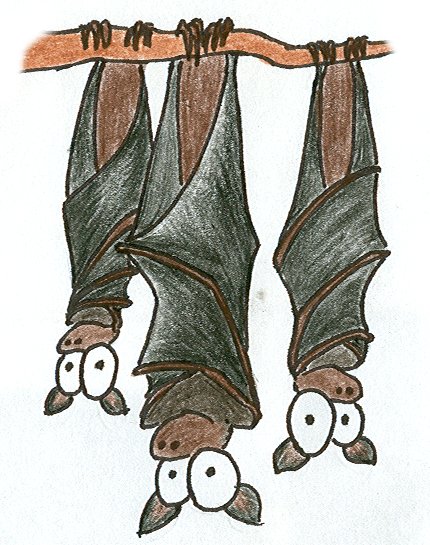
One was flying around my condominium's dim-lit neem tree last night.
…Catching mosquitoes.
I just hoped he didn't mistake me for one!
It was about 10:30 pm and I had just returned after an evening dinner with a friend of mine and looking out my third floor balcony, the neem tree whistling in the darkness looked too inviting to pass up.
But as I got down to the tree, there was this darn bat . . . skimming the tree in zig-zag circles.
And as I stood vulnerable in my evening walking shorts, the bat would come swooping down in 10 second loops on a dive-bomb collision course right toward my face!
But just at the last second . . .
Just as it was inches of crashing into me . . . with the most extraordinary timing, that little winged gymnast would do a seemingly impossible aerial acrobatic and switch directions 180 degrees. It was totally unnerving.
Do I 'really' want to go out for a walk? I asked myself. Yeek! Do I want that little creature accidentally bopping me on the head???
We all seem to have an innate and instinctive fear of bats. It probably comes from the bad reputation they've been given on television and in the movies. My environmental science education tells me that in truth, the far majority of bats are completely harmless. In fact, they're great to have around as they clear the air of mosquitoes and other pesky creatures.
But, nevertheless, I still was very hesitant.
Could I trust this bat's radar?
Bats are blind, far crying out loud!
Then I rationalized to myself, well gosh, if its internal guidance system is good enough for it to detect and catch tiny lightening-fast mosquitoes even in complete darkness, it certainly shouldn't have a problem avoiding a 180 cm, 85 kg human being strolling at less than 5 km per hour in the road!
And just as I was thinking that, I was struck by a bolt of wisdom. I remember reading an article recently about the technique to magnify our inner voice that is always present, but which we often can have a difficult time perceiving and utilizing to our maximum advantage.
Unfortunately thanks to our left-brain educational training, we are cultured from childhood to ignore that inner guidance system in favour of more logical thinking. And yet, I was like everyone else in our society, often find myself going back and forth, trying to "logically figure out" the solution to my concerns! --
"Should I go in this direction, or should I go in that direction to find greater meaning in my life?"
"Should I trust this friend or colleague who is offering me something, or should I be more cautious before moving ahead?"
"Should I let this slide, or should I say something to someone who just did or said something I don't feel quite comfortable with?"
These questions fly continuously through our heads like a swarm of bats.
But if we don't have a way to get a clear answer, we can find our self going back and forth, wondering why we don't seem to be able to get ahead, improve our relationships, or develop a much higher level of self- esteem and abundance.
So the question is . . .
Are you able to clearly hear what your inner voice is saying to you?
Or do you like I am, oftentimes feel confused, unsure whether the signal we receive is coming from our more superficial logical mind . . . and perhaps some external influence or negative past history . . .
Or is it rising up from the deepest, clearest, most pristine part of our self that 100% of the time knows what's most right and appropriate for us in order for us to increasingly experience more joy, love, inner wealth and abundance?
Now here's the REAL question . . .
How is YOUR Internal Radar System?
Is it finely tuned like the radar of the bat I was witnessing at the tree, where we are able to pluck a perfect answer and solution out of obscure darkness the way that bat at night could pluck tiny mosquitoes out of mid-air?
Or do we find ourself over-thinking and torturing yourself everyday trying to make both big and little decisions that affect our life . . . and our loved ones lives . . . just never quite sure if we're making the right decision?
That's to say . . . how certain . . . or uncertain . . . are we of our own Internal Radar?
Our own Inner Guidance System?
And how much would our life improve if we were able to easily "pluck" from all the bewildering possibilities running endlessly through our mind the one clearest, most appropriate, unmistakable signal, answer and solution to each of our great and small relationship, money and personal challenges?
Personally, I've tried to rely on my own Internal Radar System most of my adult life. It has on most occasions guided me safely and with extraordinary grace through some major life trials, as well as to living a beautiful life where every day I take both little steps and occasional major leaps to both my dreams and my God-given Vision of what that Inner Guidance System has clearly let me know I'm supposed to accomplish in my life.
My secret?
A lot of hard but joyful work . . .
Taking regular exercise and meditation breaks even when working long hour days.
And having a simple but profound system to obtain crystal clear answers and solutions to any challenge or question I may pose to myself.
I've sung this song a thousand times or more after I had met with a near-fatal accident on the 15th of August 1997. After I was declared as 40 % permanently partially disabled and a pair of crutches were given to me to sport, I felt I had lost my independence and would remain forever crippled. There are many a soul whom I owe my life and everything to what I presently am. I must express my heartfelt gratitude to Mr. Bhaskar Bhai, who rescued me and rushed me to the hospital and even went on to spend some money out of his pocket for medication... My Amma, Appa, Paati (for every prayer they performed and every blessings they showered on me), brothers--Cheenu, Kumar, Kannan, and many others in the family... who have wished that I get back well soon.
A large number of kids, specially the ones of Anandalaya, where I served for 5 academic years, Revathi, Suganthi, Saakshi, Manish, Komal, Mehul, Monark, Niranjan, Vikram, Sai, and many others who ensured that the smile lasted on my face and helped me stay sane and going.
Couple of doctors in Bhavnagar, Dr. Yashwant Doshi, Dr. Viradiya, who are like Father Figures for me...
Several of my friends who helped me through some of the most difficult times that followed between 1997 and 1999. Sunil and his daughter Suzianna, SSG, the Khannas, Manimozhi and Family, Gopal, Shivani and Family, Meena, Mamata, the list is endless...
Today after 12 years when I got to listen to this song again, I am moved... I dedicate this this song for all of them...
 A theory says ancient Egypt's Great Pyramid was built using a winding, inclined, interior tunnel through which huge blocks were pushed. The interior ramp would have required open corners (illustration at top) at which the blocks would have enough room to be rotated—probably by workers using wooden cranes—the theory says.