Tuesday, March 12, 2019

Had an interesting learning at the Kindergarten Section of our School this morning...

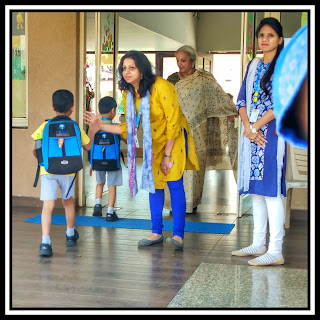
I was pleasantly surprised when I saw the teachers including the Headmistress awaiting to greet the kids, as they step-in

When I say “greet,” I really mean that every single child received an individualized greeting...

Just thinking how special I would have felt as a young student if the teachers, the only adults I trusted,  were excited to see me and all my friends, every one of us, every single morning...

How pleasing it would be to hear our teachers call us by our pet-names, compliment our dressing, the water-bottles we carry, or noticed even our new shoes, glasses or haircut.

I know – I should have been thrilled, even to see our teachers walk out the door. That's how I wish the students in my classrooms should feel: excited and ready to learn – from us.

Apart from having the students super excited to start learning every day, another great benefit, is the parents notice these...

Parents would give an amazing feedback on the positive reception their children get every day. It makes them feel so much happier when they know that the teacher is excited to see their child and, consequently, their child is so happy to be at school.

A lot of us out there, are currently parents or have been parents of young children. Isn't this exactly what we would love to see from our child's school teacher?

Even something as simple as meeting and greeting before the first bell can be a huge and positive step in building a close-knit and fun classroom community. Let's make time for it in our school schedule and see what a difference it makes.
Wednesday, October 26, 2016

Saturday, May 19, 2012

Chennai Champions Conservation


National Biodiversity Authority

The National Biodiversity Authority (NBA) was established in 2003 to implement India’s Biological Diversity Act (2002). The NBA is a Statutory, Autonomous Body and it performs facilitative, regulatory and advisory functions for the Government of India on issues of conservation, sustainable use of biological resources and fair and equitable sharing of benefits arising out of the use of biological resources.

Centre for Environment Education

Centre for Environment Education (CEE), is a Centre of Excellence, for Environmental Education and is supported by the Ministry of Environment and Forests (MoEF), Government of India. CEE is affiliated to the Nehru Foundation for Development. The primary objective of the Centre is to improve public awareness and understanding of the environment with a view to promoting the conservation and sustainable use of nature and natural resources, leading to a better environment and a better quality of life. To this end, CEE develops innovative programmes and educational material, and builds capacity in the field of education for sustainable development (ESD). 

International Day for Biological Diversity

You may be aware that the United Nations has proclaimed May 22 as the International Day for Biological Diversity (IDB), to commemorate the adoption of the text of the Convention of Biological Diversity. Marine Biodiversity is the theme for this year's International Day for Biological Diversity (IDB). The Designation of IDB 2012 on the theme of marine ecosystems provides everyone interested in marine life, the opportunity to raise awareness of the issue and induce practical action.

Attempting to create a Guinness World Records™ 

As a part of the National Celebrations of the International Day for Biological Diversity, NBA is organising a series of programmes for youth and general public. CEE Tamil Nadu, the Tamil Nadu State Office of the Centre for Environment Education (CEE) in collaboration with the National Biodiversity Authority (NBA) is attempting to create a Guinness World Records™ for the largest handprint painting in an area of approximately 6000 m² in an event organised, at the Marina Beach, Chennai, Tamil Nadu, India on 22nd May 2012.

The initiative is to garner public support and commitment for the conservation of Biodiversity. A special pledge has been developed for the citizens to express their solidarity for the efforts to conserve biodiversity. As a testimony to the commitment, we encourage every citizen to stand up for the cause for the Conservation of Biodiversity by reading the pledge and placing their handprints on one of the world’s largest canvass being developed in Chennai.

Some parts of the canvass would be taken around to different places of the city and one canvass would specially be placed at the following sites:
  1. Near the Light House, in Marina Beach, Chennai, Tamil Nadu, India
  2. Near the Marina Swimming Pool, Marina Beach, Chennai, Tamil Nadu, India
  3. Elliot's Beach, Chennai, Tamil Nadu, India
  4. Thiruvanmiyur Beach Chennai, Tamil Nadu, India


Come join the effort in conserving the World Biodiversity and be a part of the Guinness Book of World Records and experience life turning bright, and provide everlasting joy for the future!

  • Come lets commit to conservation and get the beautiful earth back!
  • Invite and mobilize all your friends to give a hand to conservation of biodiversity!
  • Date: 22.05.2012
  • Time: 04:30 to 20:30 Hrs

Needless to say, Life is bright, when the efforts are right! :~)


Looking forward to seeing you all make a visible (:~)) commitment to conserving biodiversity!

Saturday, March 27, 2010

The Lion King!


Kevin Richardson, animal ranger in Lanseria, South Africa.
HE sleeps with lions, wrestles with cheetahs and hugs hyenas - meet the "Lion Whisperer". Thirty-two-year-old Kevin Richardson spends his days - and nights - curled up with massive cats as part of his job at The Lion Park, at Lanseria, outside Johannesburg.


The South African lion whisperer has a natural affinity with some of the most dangerous animals on the planet, many of whom he names and raises by hand from birth.

"I don't use sticks, whips or chains - just patience,'' he says. "It may be dangerous, but this is a passion for me, not a job.


"I have to rely on my instincts to gauge an animal or a situation, and I will not approach a creature if something doesn't feel right.''

Mr Richardson began working with big cats - and particularly lions and hyenas - 10 years ago after quitting his career in physiology, where he worked with patients who had undergone surgery.

He wants to educate people about the big cats in a bid to save these beautiful animals.

Part of his approach is to bond intimately with the animals and they learn to treat him as a member of their pride.


"They see me as a creature they have adopted. I have also been an adopted parent in a lot of instances,'' Mr Richardson recently told South African television show Carte Blanche.

"I am someone they relate to. I enrich their lives. When I come here it's fun: we take all these animals out into the big, open spaces. If these animals are going to be kept in a captive situation, don't they deserve to have the best care, the best entertainment, the best lives?''


Mr Richardson's job is inherently dangerous. The lions at Lanseria often weigh more than 220kg and the hyenas, which are notoriously unpredictable, have the ability to bite through thick steel.


And all the big cats are fiercely protective of their young - but Mr Richardson has few fears.

"With all the animals I'm near the top (in dominance terms). You have got to be near the top. The moment they see you as a lower-order figure, they will challenge you,'' he said.

Friday, September 04, 2009

Horrors at Hatchery!

Would a factory of King Herod be similar to this or would it be more merciful. We could run a debate on this!

I really pity these poor animals, and for once am extremely proud to be a vegetarian…!

For everyone who has not had any interactions with chicken, besides chewing them from their plate, this is a must watch video! Heart breaking! The scenes that show them de-beaking and grounding the gentle chicks, is outright disgusting!

One can understand the need to separate males and females, but acting like they are not even a live breathing animal with feelings is absolutely deplorable :~( It's like Hitler’s holocaust of sorts for the chickens...

This is the very essence of an unsustainable culture.

God, how horrible! Tweety, NOOOOOOOOOOOOOOOOOO!!!!! are how, one would feel like screaming! Hang your head in shame if after having seen these horrific images, and you still continue to eat animals and their products!


Saturday, August 15, 2009

Thank You Again!

Just a short note to wish you all a Happy Independence Day and you get time to share the weekend finds you with good friends, family, and in good spirits, even if you're not celebrating anything or are celebrating something else.

I wanted to add my share of appreciation for many of you out there, who have helped me stay sane and smiling after the accident, that happened 15 years before on this very day, and my life took a complete turn. Over the last 12 years,

I am glad to inform you all with great pleasure that I have seen some success, some failures in this competition to survive… I guess, I’ve emerged a winner thanks to many of you. The first few names that come to my mind are: Bhaskar Bhai Dave a good Samaritan, who took it upon himself and rushed me to the hospital at Ahmedabad. Srinivasan and Kumar my brothers who encouraged me to survive and pulled me up from whatever state I was in. My wife Sangeetha and Son Suraj have turned me positive and look up to more life ahead.

My doctors, Dr. Ramesh Viradia, the Ortho and Dr. Yashwant Doshi who extended a helping hand more than just as a doctor….

A million and more thanks are due to several of my Friends. My special gratitude to Sunil, Meena, Shanmugam, The Khannas, Manimozhi and her kids Suganthi and Revathi, Greena, Thomas & Fen (TG), Ambika, Hema and Kirtida who went way beyond to put a smile back on my face and lent their shoulders to cry, weep and wail… Meena and Mamata thanks for having faith in me through the most insane period of my life. These days I am able to put the training I’ve had from you and have become able to put into practice in line with my responsibilities. Without your guidance, I would not have made it. Thank you again

Many a young children (who are in their prime youth these days) Suzianna, Sanjana, Chaithri, Saakshi, Fen, Revathi, Suganthi, Vikram… the endless list, whose cheerful smile and high spirit smiles and greetings have cheered me all along. Now my son, Suraj has taken that responsibility all upon him and does it with amicable ease.

I cannot also forget to remember the cheerful lunching moments in office with Gopal, Sarala, Ambika, Hema, Kalyani, Takorayan, Minaxi, Priya, Manisha Bhana, Radha, Kamlesh, who cheered me many times through the Pain-O-Therapy days...
Then finally, I would like to thank my Physiotherapists Padmashri whose high spirit of hardwork helped me ease out of those harder days of “bucling-legs”with ease.

Thank you all once again!

Thursday, July 30, 2009

Saving the Good, the Bad--And the Ugly


A hyena might not be as adorable as a tiger cub or dolphin, but a few champions of nature's endangered ugly underdogs say the hideous are just as worthy of protection as the huggable: By Katherine Harmon ( From The Scientific American)

What happens when an animal that needs saving isn't as cute as a tiger cub? Some biologists explain why human aesthetic preference has played such a big role in protecting the panda--over stranger species like this one, the helmeted hornbill.

The bulbous purple burrowing frog may not have made it onto any awww-inspiring tote bags like the unequivocally adorable giant panda. But, an increasing number of people are arguing, the humble frog—and other more homely creatures—is at least equally worth rescuing from the brink of extinction.

One of those people is Nathan Yaussy, an ecology graduate student at Kent State University in Ohio and the creator of the EUT—Endangered Ugly Things blog (recently profiled in The Washington Post). "My goal is just to let people know that these things are out there, and they're just as important as the panda," he says.

A handful of animals that are easier on the eye than, say, the aye-aye, have gotten the lion's share of publicity, funds and legislation for their salvation. Many so-called "charismatic mega-fauna," which conservationists select as mascots—or "poster children", are chosen for their looks rather than their ecological importance, notes biologist David Stokes of the University of Washington in Bothell.

"If we could raise the ecological literacy of the public and our officials to see beyond the surface value of these animals to their ecological or even utilitarian role," Stokes says, "that would be really valuable." Many endangered insects may actually be more ecologically "important" than an affable Galápagos penguin. But biologists, he notes, often neglect to take preference into account.

Certainly looks can be a matter of personal preference, but the surefire way that an animal finds its way into the public's collective heart seems to be by having infantile qualities—big eyes, round face, wobbly gait (a phenomenon called neoteny). But, as Stokes found from his research, no hard-and-fast rule dictates which animals gain wide appeal: "Really tiny differences among species can have huge effects on how much appeal they have," he says. He studied a range of penguin species and found that those with patches of bright colour received by far and away the most visual coverage.
Yaussy does admit that his method of highlighting especially bizarre animals may not be all that different than that of the panda-promoting World Wildlife Fund, a frequent target of his playful admonishment. The panda is the federation's "flagship species," he explains, which it uses with other charismatic creatures to promulgate the idea that saving the rainforest will, by extension, also save these beautiful animals. Whereas the WWF is "putting on the pretty face, I'm trying to pull in the 10-year-old boy in all of us to say, 'That's so cool!'" he remarks. At the end of the day, his hope is that "by saving the habitat, you'll save everything—the pretty things, the ugly things."

Stokes doesn't subscribe to that tidy idea entirely. Recent research has shown that the habitat of one highly endangered species rarely overlaps with that of another, he says. But he doesn't discount the usefulness of a central species for the purposes of education. The Stag Beetle Project, for instance, which is headed by the London Wildlife Trust, has helped raise awareness—and sterling pounds—for a large, fierce-looking insect.

By and large, he says, communities that can rally around one particular species, whether it's a monkey or a mollusc, do a better job adopting policies to protect biodiversity in ge
neral. But the key, he notes, is to be aware of our natural preference for some animals' appearance over others.

"This matters because people are going to increasingly be making the decision about
what species survive and what don't," Stokes says. "So we want to be able to make sure that we make educated decisions."

Sunday, June 28, 2009

Gif Animations That I Learnt

Wow! Am proud of my effort to learn GIF animations... I managed to learn to create them and also learnt to upload them on the blog! Bravo!...

Animation

These are two students of mine whom i got to meet more than a decade later... here you could see them trying to act brave with a baby python on hands...

Anglo Chinese School Students

These are the Anglo Chinese School students of Singapore who were a part of the WED programme that we conducted called, Crusaders of Climate Change". Here you could see the students trying to act brave with a baby python on hands... I like the little Sardar's expressions here... :)

Thursday, February 19, 2009

Remembering Shontal


We got her as a gift from a friend of ours as a 2 week baby. As she remained silent the entire day, we named her Shontal after the French word chanteuse—meaning “sweet voiced girl”. She has been an integral part of my life for a good number of years.

She was a Labrador retriever. She remained my constant companion and loyal friend until I met with a near fatal accident on August 15, 1997. I raised her almost as my daughter and she was a part of many a happy incidents in my life.

If you are thinking of getting a dog into your home, as a family member, remember you are making a commitment to that dog for its lifetime, probably even more than your own children.


I'm not such an expert, but I did try my hands at training Shontal for a number of years and had (accidentally?) used some of the friendly methods recommended by the a renowned, dog trainer—Mr. Ian Dunbar does in the video below.


I remember times when I started. I had no idea on dog training or education in general. My first dog was very patient, he taught me a lot. The simple rule that we followed was to teach obedience through simple play and award. Basically, I learned to appreciate every little thing that she did and said “good girl” and “thank you”.


It’s very important for us to see the world through the eyes of our beloved dogs. By knowing our pets' perspective, we can build their love and trust. It's a message that resonates well beyond the animal world.


As a result, I almost always had a happy, healthy and obedient dog. It's lovely to find out that some of my simple, easy and fun dog training methods belong to a wider philosophy on the subject!


It is essential that our dog needs to know that they can trust us and that we will never deliberately hurt or be unkind to them. All I ever had to do was call/ whistle and my dog immediately returned and were rewarded with hugs and pats.


Saturday, February 14, 2009

The Necklace...

The cheerful little girl with bouncy golden curls was almost five.

Waiting with her mother at the checkout stand, she saw them, a circle of glistening white pearls in a pink foil box.

"Oh Mommy please, Mommy. Can I have them? Please mommy Please...?"

Quickly the mother checked the back of the little foil box and then looked back into the pleading blue eyes of her little girl's upturned face.

"A dollar ninety-five. That's almost $2.00.

If you really want them, I'll think of some extra chores for you and in no time you can save enough money to buy them for yourself.

Your birthday's only a week away and you might get another crisp dollar bill from Grandma."

As soon as Jenny got home, she emptied her penny bank and counted out 17 pennies. After dinner, she did more than her share of chores and she went to the neighbour and asked Mrs. McJames if she could pick dandelions for ten cents. On her birthday, Grandma did give her another new dollar bill and at last she had enough money to buy the necklace.

Jenny loved her pearls. They made her feel dressed up and grown up.

She wore them everywhere, Sunday school, kindergarten, even to bed.

The only time she took them off was when she went swimming or had a bubble bath. Mother said if they got wet, they might turn her neck green.

Jenny had a very loving daddy and every night when she was ready for bed, he would stop whatever he was doing and come upstairs to read her a story. One night as he finished the story, he asked Jenny, "Do you love me?"

"Oh yes, daddy. You know that I love you."

"Then give me your pearls."

"Oh, daddy, not my pearls. But you can have Princess, the white horse from my collection, the one with the pink tail. Remember, daddy? The one you gave me. She's my very favourite."

"That's okay, Honey, daddy loves you. Good night." And he brushed her cheek with a kiss.

About a week later, after the story time, Jenny's daddy asked again, "Do you love me?" "Daddy, you know I love you."

"Then give me your pearls."

"Oh Daddy, not my pearls. But you can have my baby doll. The brand new one I got for my birthday. She is beautiful and you can have the yellow blanket that matches her sleeper."

"That's okay. Sleep well. God bless you, little one. Daddy loves you."

And as always, he brushed her cheek with a gentle kiss.

A few nights later when her daddy came in, Jenny was sitting on her bed with her legs crossed Indian style.

As he came close, he noticed her chin was trembling and one silent tear rolled down her cheek.

"What is it, Jenny? What's the matter?"

Jenny didn't say anything but lifted her little hand up to her daddy.

And when she opened it, there was her little pearl necklace. With a little quiver, she finally said, "Here, daddy, this is for you."

With tears gathering in his own eyes, Jenny's daddy reached out with one hand to take the dime store necklace, and with the other hand he reached into his pocket and pulled out a blue velvet case with a strand of genuine pearls and gave them to Jenny

He had them all the time. He was just waiting for her to give up the dime-store stuff so he could give her the genuine treasure.

So it is, with our God. He is waiting for us to give up the cheap things in our lives so that he can give us beautiful treasures.

Isn't God good? Are you holding onto things that God wants you to let go of?

Are you holding on to harmful or unnecessary partners, relationships, habits and activities that you have come so attached to that it seems impossible to let go?

Sometimes it is so hard to see what is in the other hand but do believe this one thing ...

God will never take away something without giving you something better in its place.

The greatest gifts happen when you share love and touch.

Happy Valentine's Day

Wednesday, February 11, 2009

Worms & Us

Take a trip to meet the charming, slinky creatures that turn your innards into their home sweet home

Worms have been living inside the human body since Homo sapiens have been around. About half the world's population (over 3 billion people) are in infected with at least one of the three worms—large
roundworm, hookworm and whipworm. Most of those afflicted live in developing countries, where there is not enough clean drinking water or effective sanitation systems to keep infected feces from contaminating food and water, and where human excrement is used to fertilize crops. As you browse ahead, please remember that all of these infections are treatable.

Hookworm

Unlike most parasitic worms, which invade the body through the stomach, hookworm larvae can wiggle in through sweat glands or hair follicles in the skin. This typically happens when people walk, sit or lie on dirt containing human feces contaminated by hookworm larvae. Through the skin and into the blood vessels, the larvae make their way to the lungs, causing coughing and shortness of breath; they then migrate to the throat, where they are swallowed and delivered to the small intestine. They mature into adults measuring about 0.4 inch (10 millimeters) long, causing symptoms such as abdominal pain and anemia—a result of the worm sucking blood out of the intestinal walls. Some 740 million people, mostly those living in the warm, moist climates of Africa, Latin America, Southeast Asia and China, suffer from hookworm infections, according to the World Health Organization (WHO).

The Large Roundworm (Ascaris)

Ascariasis, the potentially deadly disease caused by the roundworm Ascaris, is the most common worm infection in humans, affecting as many as 1.5 billion people worldwide annually and striking hardest in tropical and subtropical regions with poor sanitation, according to the U.S. Centers for Disease Control and Prevention (CDC). People often catch ascariasis by ingesting vegetables or fruit grown in soil fertilized with human feces contaminated with its eggs. On hatching in the intestine, the eggs develop into larvae that migrate through the blood and lymph systems into the lungs, causing fever, shortness of breath and wheezing. (Some people actually cough up the larvae.) From the lungs, the larvae make their way up into the throat; there they are swallowed and passed into the small intestine, where they grow into adulthood. (Imagine earthworms as long as one foot, or 30 centimeters, crawling around in your small intestine.) Severe infections can lead to intestinal blockage and death. The WHO estimates that ascariasis causes 60,000 deaths per year, mainly in children.

A Whipworm
Trichuris trichiura, co
mmonly known as a whipworm because it looks like a cow whip, grows up to about two inches (50 millimeters, or as long as a thumb). The most common way to catch whipworm is by ingesting dirt containing human feces that are loaded with its eggs (think: children playing in the dirt and then putting their fingers in their mouths). The whipworm, which sets up shop in the large intestine, is what Despommier says may be "the secret to curing Crohn's disease."

Patients with Crohn's disease—an
autoimmune disorder in which the intestinal tract becomes chronically inflamed, leading to symptoms such as diarrhea, abdominal pain and rectal bleeding—are believed to have small proteins that resemble whipworm proteins jutting from the surfaces of their intestinal cells. Mistaking the protein protrusions for those of a whipworm, the immune system attacks them, causing Crohn's disease, Despommier explains. Studies have shown that when Crohn's patients are infected with whipworm, the body seems to redirect its focus away from its own cells and onto the worms, causing Crohn's symptoms to disappear. The problem with treating Crohn's disease with whipworm, of course, is that the worm causes its own suite of problems, including severe diarrhea, weight loss and anemia. Severe cases [see photo inset] can lead to rectal prolapse, a condition in which the walls of the rectum actually protrude from the anus.

Worldwide, some 800 million people, mostly children in tropical and subtropical climates, are infected with whipworm, according to the National Institute of Allergy and Infectious Diseases.

Lymphatic Filariae

Unlike most parasitic w
orms, which inhabit the intestines, lymphatic filariae live in the lymphatic vessels and nodes. For reasons not completely understood by scientists, the presence of these worms in the lymph system can lead to severe inflammation called elephantiasis, which often affects the legs, arms, genitals and breasts [see photo]. Unfortunately for men, the worms have a propensity for the male genitalia. The worms get inside a person's body when a mosquito carrying their larvae sinks its proboscis into a victim's skin. The larvae travel through the skin and into the lymph vessels where they mature into adults measuring as long as four inches (100 millimeters). According to WHO, the infection usually begins in childhood but often takes years to cause elephantiasis.

Some 120 million peo
ple, mostly in the warm, humid climes of south Asia, Africa and the Americas, are infected with these tiny worms, and more than 40 million are disfigured by the infection, according to WHO.

Ta
peworm
People accidentally ingest immature worms by eating raw or undercooked pork. Once the worms pass into the intestines, they latch onto the intestinal walls with suckers and hooks and begin to grow—and grow. The pork tapeworm shown here, Taenia solium, can grow as long as 20 feet (six meters). Often, people don't even know they have tapeworm until they see the worms—or pieces of them in their stool. If a person ingests the tapeworm eggs (by, for example, drinking water contaminated by egg-laden human feces), the eggs hatch into larvae the stomach and travel into the small intestine. From there, they may enter the bloodstream and migrate to the muscles, eyes or brain, where they can cause seizures, headaches and potentially fatal brain swelling.

Now, if you are interested in teaching your children on the importance of wearing footwear, you could use the video shown below.


Pinworm

Pinworm is the most ubiquitous parasitic worm infecting people in temperate climates—places like the U.S., Europe and most of China, which are neither tropical nor polar, but have four seasons. Nearly all children catch pinworm before they reach age 12 (yes, that means you, too) by digesting tiny bits of fecal matter from other kids. Pinworm inhabits the colon and rectum, feeding on Escherichia coli (E. coli) bacteria in the stool. Late at night when children are asleep, the female pinworm, which measures about the length of a staple (0.5 inch or 13 millimeters), emerges from the anus and lays her eggs on the surrounding skin. The eggs are itchy, causing children to scratch and contaminate their fingers. When they suck their thumbs, or touch other children who suck their thumbs, the cycle starts all over again.

Monday, December 08, 2008

An Ode to a Friend...

An ode to that friend....

I don't have many people
But I do have you

Not often do I open up
But you know all that is true

You have stuck through it all

Seen me at my worst

Saw me fall in love

With zack, and also with my first


You never judge me

Or even let me down

Always reassured me the best

Picking me up off the ground


But things have changed

And I worry for this route

If things get any worse

I will have some serious doubt


You are my all time best friend

always one I can go to

But we are drifting apart

In life, I have to have you


You are closer than a sister

And nicer than a saint

I couldnt change a thing

Or give you a complaint


I just dont want to loose you
Because we are drifting apart
I would be so lost in this world
You are a part of my heart

Know I am always here for you
Even during this rough patch

If you ever want to fall

Ill be there ready to catch


So lets put more effort forth

And try to re-patch our mistakes

Because id hate to loose years of joy

And this friendship to break

This is a small effort from me to patch up with a friend, who was worth the Earth! Someone, who promised to stand by me, decided to fall out for some lousy spam mail [(am not aware what it exactly was...;-)] that went in my name... Alas, I wasn't even given a chance to explain my position...
ramjee

Friday, November 21, 2008

The Great Pyramid Mystery

A theory says ancient Egypt's Great Pyramid was built using a winding, inclined, interior tunnel through which huge blocks were pushed. The interior ramp would have required open corners (illustration at top) at which the blocks would have enough room to be rotated—probably by workers using wooden cranes—the theory says.

The theory may be supported by new ideas about a hidden room high in the pyramid's outer wall. Egyptologist Bob Brier, shown entering the space, says it is in fact one of those open corners, long since walled in.


Illustration and photograph courtesy Jean-Pierre Houdin


Pyramid Mystery to Be Solved by Hidden Room...
By Brian Handwerk
for National Geographic News


ON TV
Unlocking the Great Pyramid airs Sunday, November 23, at 7 p.m. ET on the National Geographic Channel.

A sealed space in Egypt's Great Pyramid may help solve a centuries-old mystery: How did the ancient Egyptians move two million 2.5-ton blocks to build the ancient wonder?

The little-known cavity may support the theory that the 4,500-year-old monument to Pharaoh Khufu was constructed inside out, via a spiraling, inclined interior tunnel—an idea that contradicts the prevailing wisdom that the monuments were built using an external ramp.

The inside-out theory's key proponent, French architect Jean-Pierre Houdin, says for centuries Egyptologists have ignored evidence staring them in the face.

"The paradigm was wrong," Houdin said. "The idea that the pyramids were built from the outside was just wrong. How can you resolve a problem when the first element you introduce in your thinking is wrong?"

Theories Abound
Even the most widely held Great Pyramid construction theories have flaws, Egyptologist Bob Brier said.

For example, a single, straight external ramp would have been impractical, said Brier, of Long Island University in New York.

To deliver blocks to the 481-foot (147-meter) peak at a reasonable grade, the ramp would have had to have been a mile (1.6 kilometers) long and made of stone. And over the decades of the pyramid's construction, workers would have had to continually increase the ramp's height and length as the pyramid rose.

Video Clip From Unlocking the Great Pyramid Documentary


"That's like building two pyramids. And we've never found the remains of such a ramp," Brier said.

Another theory suggests a stone ramp wound around the outside of the Great Pyramid. But an outside ramp would have obscured the pyramid's surface—making it impossible for surveyors to use the corners and edges for necessary calculations during constructions, Brier said.

Greek historian Herodotus, writing around 450 B.C., theorized the use of small, wooden, cranes or levers to lift the blocks.

But, Brier said, "you'd have to have thousands, and they didn't have enough wood in all of Egypt for that," Brier said.

Obsession
For Houdin, the Paris architect, the puzzle of the pyramid is a family affair. His father, a civil engineer, came up with the idea of an internal construction ramp a decade ago.

Houdin was soon hooked, as suggested by his recent book, co-written by Brier—The Secret of the Great Pyramid: How One Man's Obsession Led to the Solution of Ancient Egypt's Greatest Mystery.

Houdin eventually left his architecture firm to pursue the inside-out theory full-time.

For what they thought would be a matter of weeks, he and his wife moved into a 236-square-foot (22-square-meter) studio apartment. They ended up staying for four years, as Houdin toiled away at his self-financed project.

Outside Ramp, Then Internal Tunnel

Houdin's theory suggests the Great Pyramid was built in two stages.

First, blocks were hauled up a straight external ramp to build the pyramid's bottom third, which contains most of the monument's mass, Houdin believes.

Houdin says the limestone blocks used in the outside ramp were recycled for the pyramid's upper levels, which might explain why no trace of an original ramp has been found.

Egyptian-archaeology specialist Josef Wegner sees merit in the recycling idea.

"The notion of using the already quarried smaller blocks to build the lower ramp and then dismantling that for use in upper sections would be a very logical approach to speed up the overall construction process," said Wegner of University of Pennsylvania Museum of Archaeology and Anthropology.

After the foundation had been finished, workers began building an inclined, internal, corkscrew tunnel, which would continue its path up and around as the pyramid rose, Houdin said.

Because the tunnel is inside the pyramid, Brier said, "when they finished getting blocks all the way up to the top this ramp disappeared."

New Clue: The Hidden Room

New evidence uncovered about two-thirds of the way up the Great Pyramid supports the inside-out theory, said Houdin, the architect.

At about the 300-foot (90-meter) mark on the northeastern edge lies an open notch.

On a recent expedition with a National Geographic film crew, Brier—aided by a videographer with mountain-climbing experience—scaled perilous crumbling rocks to reach the notch. (The National Geographic Society owns National Geographic News.)

Ducking inside the notch, Brier entered a small L-shaped room.

He wasn't the first to visit the space, but until now Egyptologists had taken little notice of it.

Houdin, the architect, said the feature figures perfectly with his theory.

Open Corners for Turning Blocks?

For the interior tunnel to work, it would have required open areas at the Great Pyramid's four corners, Houdin says. Otherwise the blocks wouldn't have been able to clear the 90-degree turns.

Like railroad roundhouses, these open corners would have given workers room to pivot the blocks—perhaps using wooden cranes—so the stones could be pushed into the next tunnel.

The notch and room are remnants of one such opening, Houdin claims. They are located at one of the spots where Houdin's 3-D computer models suggest they should be.

Inside the corner space, which was apparently walled in as the pyramid was completed, there should be two tunnel entrances at right angles to one another—each leading to a section of the internal ramp, Houdin believes.

Perhaps all that stands between him and the solution to the mystery are massive blocks that thousands of years ago sealed the tunnel, Houdin said.

If this previously known space truly is the missing link in the puzzle of the Great Pyramid's construction, the question remains why no one would have surmised this by now.

Brier said, "If you weren't thinking about internal ramps and notches and you climbed right by this thing, it wouldn't mean anything to you."

The Other Key Clue

Prior to the room brainstorm, Houdin's most important piece of evidence was the product of good luck.

In 1986 a French team in an ultimately fruitless search for hidden chambers in the Great Pyramid had done a survey of the monument's density using a technique called microgravimetry, which measures the strength of local gravitational fields.

Nearly 15 years later, Houdin was presenting his ramp theory at a conference and was approached by a member of the 1986 team.

The man showed Houdin an image from their survey that they'd dismissed as unexplainable.

But to Houdin, and later Brier, the explanation was clear.

The image shows what looks like a spiraling feature inside the structure's outer walls.

"If I hadn't seen that diagram, I'd probably be thinking this is just another theory," Brier said.

Next Step: Confirmation


The 1986 image, the notch room, and other evidence may make Houdin's theory plausible, but the case is far from closed.

"As with all archaeological theories, the proof is in the pudding, and many logical and compelling theories have fallen by the wayside under the weight of hard evidence," said the University of Pennsylvania's Wegner.

But "verification of the proposed internal spiral ramp would be a remarkable and groundbreaking discovery," Wegner added.

Houdin believes that verification might soon be possible.

He suggests that an infrared camera—positioned about 150 feet (46 meters) from the pyramid—could potentially record subtle differences in interior materials and temperatures. Those variations could reveal clear-cut "phantoms" of the internal ramp.

"What we need is the authorization, by the Egyptian authorities, to stay around for 18 hours, close to the pyramid, with a cooled infrared camera based on an SUV and to take images of three [pyramid] faces every hour during this period," Houdin said.

"A green light from Cairo and the Great Pyramid mystery is over."

Source: National Geographic News..

Tuesday, November 04, 2008

Word Riddle

Am sure all of us must have played riddles with at sometime are the other. The most common and interesting ones i've enjoyed hearing often include:

  1. Name the longest English word?
  2. A headless man had a letter to write; It was read by a man who had lost his sight. The dumb repeated it word for word; And deaf was he who listened and heard.
I learnt about a new one that was interesting in many ways...
Here it goes...

  • What common English word is 9 letters long, and each time you remove a letter from it, it still remains an English word; from nine letters all the way down to a single remaining letter?
To find the answer for this latest one, watch the video below.


Fun Word Riddle - Click here for more home videos


Just in case you were not able to get the answers for the two questions above...
  1. Smiles... There's a mile between two 'S'
  2. The letter in question is the letter "O". It is zero. The man had nothing to write. The blind could read nothing. The person who was dumb could repeat nothing. The deaf man listened and heard nothing.

Sunday, October 26, 2008

When I Am Not Looking....


When you thought I wasn't looking…
Align Center
I saw you hang my first painting on the wall,

and I immediately wanted to paint another one.


When you thought I wasn't looking…

I saw you feed a stray cat,

and I learnt that it was good to be kind.


When you thought I wasn't looking…

I saw you make my favourite cake for me,

and I learnt, even little things are special in life.


When you thought I wasn't looking…

I heard you say a prayer,

and I knew that there is a God and I learned to trust in Him.


When you thought I wasn't looking…

I saw you make a meal for a friend who was sick,

and I learned that we all have to help each other.


When you thought I wasn't looking…

I saw you help people who had nothing,

and I learned that those who have something should give to those who don't.


When you thought I wasn't looking…

I saw you take care of our house & everyone in it,

and I learned to take care of what we have.


When you thought I wasn't looking…


I saw how you handled your responsibilities, even when you didn't feel good,

and I learned that I would have to be responsible when I grow up.


When you thought I wasn't looking…


I saw tears come from your eyes,

and I learned that sometimes things hurt, but it's all right to cry.


When you thought I wasn't looking…

I saw that you cared,

and I wanted to be everything that I could be


When you thought I wasn't looking…

I learned most of life's lessons that I need to know to be a good

and productive person when I grow up.


When you thought I wasn't looking…

I looked at you and wanted to say,

'Thanks for all the things I saw


When you thought I wasn't looking.'


I am sending this to all of the people I know who do so much for others,

but think that no one ever sees.

Little eyes see a lot…


Each one of us -

Parent, Grandparent, Aunt, Uncle, Friends, Teachers…

Influence the life of a child.

Let's be a positive influence on the children around us